Showing posts with label Social media. Show all posts

Friday, 28 March 2014

Facebook To Use Drones, Satellites and Lasers To Deliver Internet Around the World

Facebook's next big ambitious project is to make Internet accessible to everyone around the world.  To make it happen, Facebook CEO Mark Zuckerberg has announced that they will use drones, satellites and lasers.
On Thursday, March 27, Zuckerberg posted a status on Facebook, sharing some updates about the frontier and giving a few hints on their future plans to reach the goal.
"We've made good progress so far. Over the past year, our work in the Philippines and
Paraguay alone has doubled the number of people using mobile data with the operators we've partnered with, helping 3 million new people access the internet," wrote the 29-year-old Internet entrepreneur.
Zuckerberg said that Facebook will continue their partnership with the operators in the two countries, but claimed that the online social networking service will need new technology to reach other parts of the world, and that is currently what Facebook's Connectivity Lab is working on.
At the latter part of the post, Zuckerberg revealed that Facebook is currently collaborating with NASA's Jet Propulsion Lab and Ames Research Center for the grand initiative, and announced that the team has just gotten bigger now that they are also working with a small UK-based company Ascenta for a connectivity aircraft. Founders of the said company were the one's responsible for the early versions of Zephyr, the longest flying solar-powered unmanned aircraft in the world.
According to a press release published on Internet.org,  two thirds of the world's population doesn't still have access to Internet, and in order to connect them to the world, the team is currently developing new delivery platforms.
"The team's approach is based on the principle that different sized communities need different solutions and they are already working on new delivery platforms-including planes and satellites-to provide connectivity for communities with different population densities," the press release detailed.

Friday, 21 March 2014

Facebook Disputes Claims That They Were Aware Of NSA Data Collection Outside Of FISA Orders


The Guardian newspaper made headlines yesterday for a story claiming the tech companies were not entirely truthful about their knowledge of National Security Agency spying. News outlets quickly picked up the accusations from NSA General Counsel Rajesh De that tech companies had “full knowledge” of the controversial surveillance of their users.
From the beginning of the NSA scandal last summer, tech companies have furiously denied that the NSA had direct access to their data. They have also denied knowing anything about the program that apparently allows the NSA to forcibly demand user data, known as PRISM. Moreover, they have publicly lobbied the U.S. Government to permit them to disclose the number of users that have been surveilled by the NSA, authorized by the Foreign Intelligence Surveillance Court (FISC).
Companies suing the government for the ability to be more transparent eventually won that case, and have since disclosed — within still harsh restrictive bounds — more information on government data requests.
Thus, Facebook quickly denied the new accusations. In a statement, the company told TechCrunch:
“Before it was reported in the news, we had never heard of ‘PRISM’ or any program in which Internet companies, voluntarily or otherwise, gave the government direct access to servers or in any way facilitated the bulk collection of user data. At the same time, we never suggested that we were not aware of our obligations under FISA, which was the topic of today’s hearing. In fact, we have been fighting for more transparency around the lawful national security-related requests from the U.S. Government that we may receive under this statute. The suggestion that we were misleading the public is frustrating and untrue.”
Soon after we received this statement, The Guardian issued a major “amendment” to their story.
“This article was amended on 20 March 2014 to remove statements in the original that the testimony by Rajesh De contradicted denials by technology companies about their knowledge of NSA data collection. It was also updated to clarify that the companies challenged the secrecy surrounding Section 702 orders. Other minor clarifications were also made.”
Section 702 refers to a law that permits some of the more controversial intelligence agency surveillance programs 
When asked whether The Guardian still stands by their original interpretation of the story, spokesman Gennady Kolker wrote back, “The article was amended to clarify and correct our reporting, in line with the Guardian’s policy and practices.”
In the original piece, The Guardian wrote the following:
The senior lawyer for the National Security Agency stated unequivocally on Wednesday that US technology companies were fully aware of the surveillance agency’s widespread collection of data, contradicting month of angry denials from the firms.
The NSA’s Wednesday comments contradicting the tech companies about the firms’ knowledge of Prism risk entrenching tensions with the firms NSA relies on for an effort that Robert Litt, general counsel for the director of national intelligence, told the board was “one of the most valuable collection tools that we have.
Now the passages read as follows:
The senior lawyer for the National Security Agency stated on Wednesday that US technology companies were fully aware of the surveillance agency’s widespread collection of data.
De and his administration colleagues were quick to answer the board that companies were aware of the government’s collection of data under 702, which Robert Litt, general counsel for the director of national intelligence, told the board was “one of the most valuable collection tools that we have.
Note that these sections have now been stripped of anything about De’s statements “contradicting” the companies’ insistence that they have not participated. The piece still asserts that the companies were aware of the governments collection under Section 702 — the FISA Amendments Act — with De replying yes to a question about whether the data collection occurred with the “full knowledge and assistance of any company from which information is obtained.”
The amendments to the article scaling back De’s statements reflect the difficulty in covering a story that has been shrouded in secrecy–a secrecy that has frustrated by citizens and tech companies alike. President Obama has proposed several changes to Intelligence Agency surveillance, but any major transparency reforms will have to wait until congress takes up the issue later this year.
Google did not respond to a request for comment, and Yahoo and Microsoft had no comment.

Thursday, 20 March 2014

Facebook Creates Software That Matches Faces Almost as Well as You Do


Facebook’s new AI research group reports a major improvement in face-processing software.

Questioned no matter if a couple of not really acquainted images connected with people demonstrate the identical man or women, a people are certain to get it proper ninety seven. 53 % of times. Completely new application manufactured by scientists from Facebook can easily report ninety seven. 25 percent about the same difficult task, no matter versions with lighting effects or even whether or not the man or women from the image is specifically dealing with this digital camera.

That’s an important move forward over past face-matching application, and it illustrates the energy of your completely new way of artificial cleverness known as heavy understanding, which Facebook as well as opposition possess bet intensely with in the past season (see “Deep Learning”). This subject of AI entails application which employs cpa networks connected with simulated neurons to master to acknowledge styles with copious amounts connected with data.


“You typically don’t make sure type of advancement, ” says Yaniv Taigman, part connected with Facebook’s AI crew, an investigation class designed recently to be able to examine the way heavy understanding may also help the corporation (see “Facebook Launches Sophisticated AI Effort”). “We strongly tactic man effectiveness, ” says Taigman of the completely new application. He / she information that this malfunction pace may be reduced by means of more than a 1 fourth relative to sooner application that may consider about the same task.


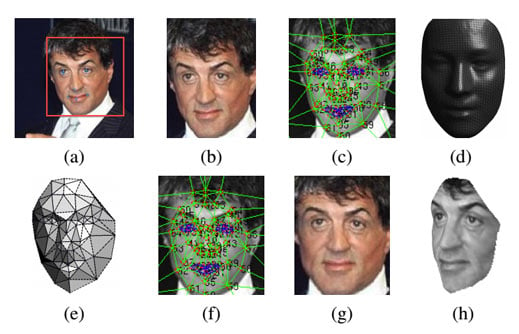
Go convert: DeepFace uses a 3-D design to be able to turn people, essentially, to experience this digital camera. Image (a) indicates the original graphic, and also (g) indicates the ultimate, repaired version.

Facebook’s completely new application, known as DeepFace, does what scientists call face confirmation (it recognizes which a couple of pictures demonstrate the identical face), not necessarily face acknowledgement (putting a name to a face). Yet some of the actual strategies could possibly be placed on which dilemma, says Taigman, and also may as a result enhance Facebook’s reliability from hinting that with whom end users should tag within a recently submitted picture.

However, DeepFace is always simply an investigation task for the moment. Facebook unveiled an investigation document on the task yesterday, as well as the scientists will present the project with the IEEE Convention with Laptop or computer Imaginative and prescient vision and also Structure Identification with August. “We are generally posting our results to acquire feedback through the exploration neighborhood, ” says Taigman, that formulated DeepFace in addition to Facebook friends Ming Yang and also Marc’Aurelio Ranzato and also Tel Aviv School mentor Lior Hair.

DeepFace procedures pictures connected with people with a couple of steps. Primary it corrects this angle of your experience so that the man or women from the image people ahead, employing a 3-D style of an “average” forward-looking experience. Then a heavy understanding also comes in being a simulated sensory network breaks down to a numerical account of the reoriented experience. In the event DeepFace pops up along with similar enough information through a couple of distinct pictures, it makes a decision they should demonstrate the identical experience.

The actual effectiveness of the last application ended up being tried in opposition to a normal data fixed which scientists make use of to be able to benchmark face-processing application, which has been employed to determine the way individuals cost from corresponding people.

Neeraj Kumar, a examiner with the School connected with California that has done experience confirmation and also acknowledgement, says which Facebook’s final results demonstrate the way acquiring enough data to be able to supply right into a big sensory network allows pertaining to significant changes with machine-learning application. “I’d bet large amounts of this acquire the following arises from what heavy understanding generally offers: to be able to leveraging a large amount connected with outdoors data within a much higher-capacity understanding design, ” this individual says.

The actual deep-learning section of DeepFace consists of seven cellular levels connected with easy simulated neurons, with an increase of than 120 zillion internet connections among these people. To train which network, Facebook’s scientists drawn on a smaller slice connected with data from other company’s hoard connected with individual images—four zillion images connected with people belonging to virtually some, 000 men and women. “Since that they get access to a lot of data on this style, they are able to successfully prepare a high-capacity design, ” says Kumar.

Disqus

comments powered by Disqus