Showing posts with label Hacking. Show all posts

Sunday, 25 May 2014

US considers blocking Chinese nationals from hacking conferences

Following its decision to charge five Chinese officials for allegedly stealing trade secrets, the US is apparently ready take further action. Reuters reports that the US government may impose visa restrictions on Chinese computer experts, stopping them from attending the high-profile Def Con and Black Hat hacking conferences in August. Black Hat currently has three Chinese speakers lined up to present, while Def Con has none on its roster. The move is said to be part of a "broader effort to curb Chinese cyber espionage," after cybercriminals were said to have infiltrated six American private-sector companies to help give Chinese state-owned firms a competitive advantage. Organizers of both events, which include the founder of Def Con and Black Hat Jeff Moss, were unaware of the government's plans, but Moss did note on Twitter that such actions would not help build a "positive community." While an official block has yet to be imposed, stopping Chinese nationals already in the country from attending could prove difficult: Def Con's privacy-conscious setup requires attendees to pay using only cash and they never have to share their name.

Saturday, 12 April 2014

Pay with Your Fingerprint

Samsung’s Galaxy S5 is the first smartphone that can use a fingerprint to authorize payments in stores and online.

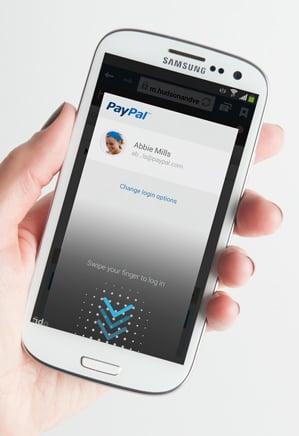
Anyone with an iPhone 5 can use its fingerprint reader to unlock the device and pay for apps or music in Apple’s iTunes store. Owners of Samsung’s latest flagship device, the Galaxy S5 smartphone, which launches on April 11, will be able to make much broader use of their fingerprints to pay for things. If they visit a website or app that accepts PayPal using the device, they can authorize payments by swiping a finger across the phone’s home button. And PayPal’s own mobile app can be used to pay for goods in some physical stores in the U.S.

Fingerprint payments are likely to be offered on many more smartphones in the near future. The Galaxy S5’s payments system is the first commercial deployment of a new protocol developed by the FIDO Alliance, a group founded by tech companies to end our reliance on insecure passwords (see “PayPal, Lenovo Launch Campaign to Kill the Password”). Indeed, fingerprint readers are expected to become commonplace on mobile devices over the next year or so (see “A Technological Assault on the Password”).

“Today people are having to type in nine-digit passwords everywhere, including one-handed on the subway,” says Joel Yarbrough, senior director of global product solutions at PayPal. This leads many people to use simple passwords and to reuse them across multiple services. This, in turn, makes it easier for criminals to take control of accounts. “Building a smart biometric experience solves both usability and dramatically increases the security level,” says Yarbrough.

To start using your finger for payments on the new Samsung phone, you have to go through a short setup process that registers the identity of the device, based on its cryptographic chip, and links your fingerprint to a PayPal account. Afterward, PayPal’s software asks for a fingerprint swipe anytime an app or site would usually show a log-in screen.

mobile phone showing UI
Fingertip swipe: The fingerprint sensor in Samsung’s upcoming flagship smartphone can be used to make PayPal payments online, in mobile apps, and in physical stores.

The FIDO protocol is designed so that a record of your fingerprint never leaves your device. Instead, the fingerprint reader’s output is used to generate cryptographic keys that are combined with those from the device’s cryptographic chip to create a new key that can’t be used to copy the fingerprint used to make it.

The Galaxy S5 is so far the only device to support PayPal’s new FIDO-based fingerprint system, and PayPal is cagey about how soon others might appear. But Yarbrough acknowledges that Samsung isn’t the only gadget maker looking at fingerprint readers. “It’s our impression that a lot of manufacturers are investing time in this technology,” he says. Brett McDowell, senior security advisor at PayPal and vice president of the FIDO alliance, says widespread adoption is “core to the mission of the alliance.”

The FIDO Alliance was launched in early 2013, and now has over 100 members, including Microsoft, Google, device manufacturers such as Lenovo and LG, and representatives of the payments industry such as PayPal and Mastercard. Apple, which has its own fingerprint authentication technology, is not a member of the FIDO Alliance.
mobile phone showing UI

Sebastien Taveau, formerly chief technology officer of Validity, a fingerprint sensor company acquired in October by Synaptics, says fingerprint sensors will soon be widespread. Apple and Samsung—the two largest mobile device makers—have now made fingerprint authentication major features of their flagship devices, he points out, and competitors will likely follow their lead. “It is expected that other devices, like tablets, will be incorporating a sensor.”


Most of the core technology needed for biometric authentication has been around for years. Taveau says that cultural change means we are now ready to embrace the idea. “With the transformation of user interactions with content from local to cloud-based and the collapse of trust in existing authentication mechanisms, a real change is happening,” he says, pointing to the public awareness of security flaws heightened by the NSA leaks and the Target debit card breach. “Trust in security and credentials need to be reëstablished.”

Via: MIT Technology Revi

Thursday, 27 February 2014

Hackers plot Brazil World Cup 2014 cyber attacks

Hackers are planning to launch cyber attacks to disrupt the 2014 World Cup, with one cyber security expert telling Reuters: “It's not a question of whether the cup will be targeted but when.”

The eyes of the world will be on Brazil this summer.
GettyImagesThe eyes of the world will be on Brazil this summer.
Brazil has already endured significant problems in the build-up to this summer’s tournament, with the public launching large-scale protests over the exorbitant cost of hosting.
Reuters reports that online activists are now planning to launch attacks ranging from jamming websites to data theft.
Brazil has significant problems with internet crime but, despite concerns over a lack of investment in online security, the head of the cyber command for the nation’s army, General Jose Carlos dos Santos, is remaining cautiously optimistic.

It appears supporters are not the intended targets, with one activist telling Reuters: “The attacks will be directed against official websites and those of companies sponsoring the cup.”
“It would be reckless for any nation to say it's 100 percent prepared for a threat, but Brazil is prepared to respond to the most likely cyber threats,” he said.
However, Terra reported earlier this month that hackers are looking to steal data and spread viruses by sending out emails claiming supporters have the opportunity to win tickets.
Nelson Barbosa, of computer security corporation Symantec, said: “Threats relating to the World Cup can affect people all around the world. This has been carried out in South Africa, Russia and other European countries.”
With hackers viewing the World Cup as an opportunity to attract the attention of a global audience, William Beer, a cyber security expert with consultancy firm Alvarez & Marsal, said online attacks were inevitable.
“It's not a question of whether the cup will be targeted but when, so resilience and response become extremely important,” he said.

Disqus

comments powered by Disqus